Hexana 0.11 Release Notes
This page covers the 0.11 release line: 0.11 (2026-06-11) and the 0.11.1 patch (2026-06-17).
- 0.11.1 adds a module-to-module WebAssembly diff — structural function matching, a supply-chain view of newly-introduced imports, and an on-demand WAT comparison — and recognises Kotlin/Wasm modules, badging functions and navigating to their Kotlin source declarations.
- 0.11 adds two new WebAssembly run/debug runtimes — Node.js and the browser — recognises GraalVM Native Image binaries, and reads their embedded CycloneDX SBOM, including matching components against the OSV vulnerability database and reporting which CVEs actually survived the image's dead-code elimination.
0.11.1 — Module diff and Kotlin/Wasm
Released 2026-06-17. No breaking changes from 0.11.
Compare two WebAssembly modules
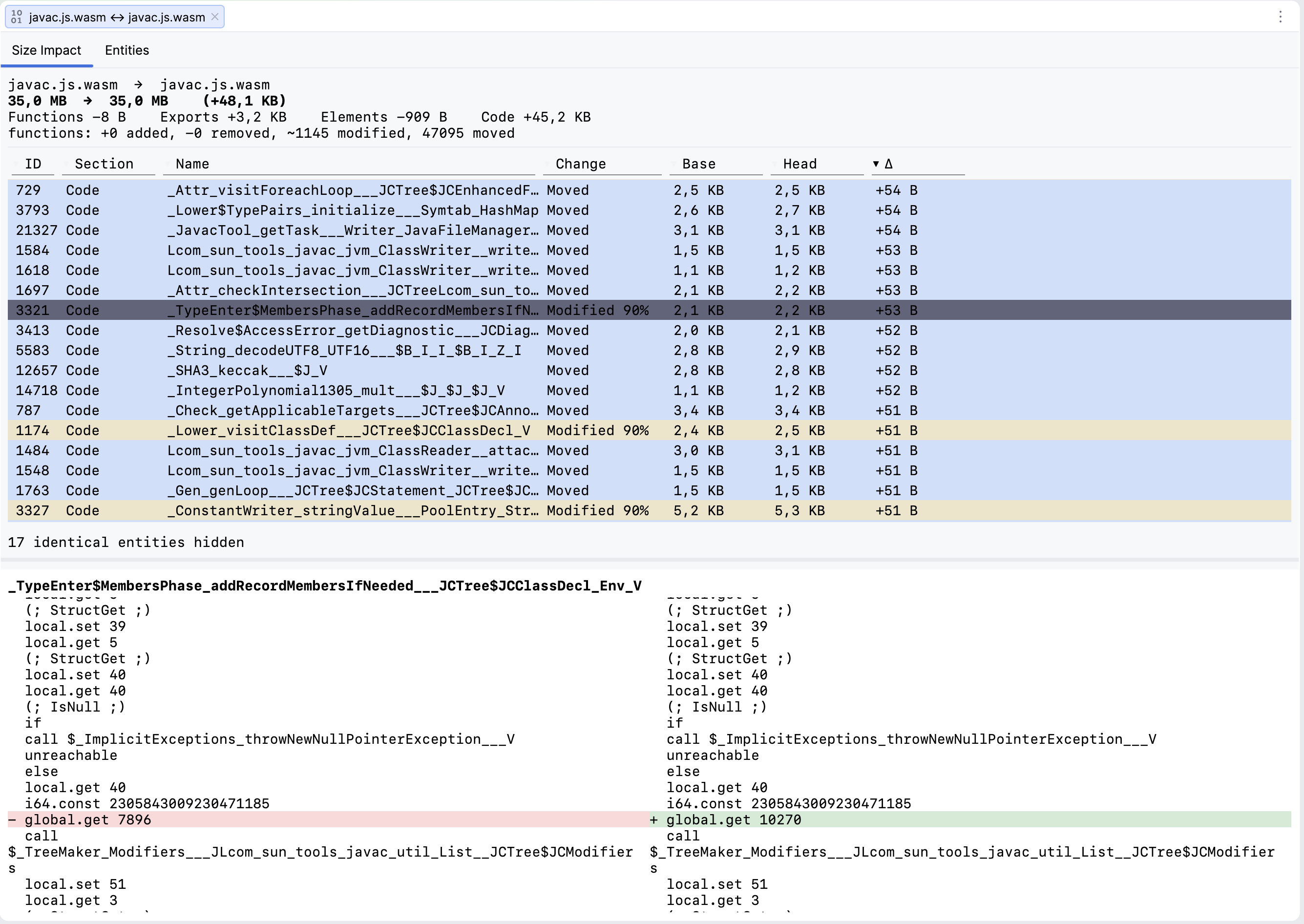
Compare WASM With… — from a .wasm file's project-view context menu or the Tools menu — opens a diff editor for two modules.
- Size Impact tab — per-section and per-function byte deltas, sorted by impact. Functions are paired with a semantic matcher (content hash + call graph) rather than by position, so inserting or removing a function no longer mis-attributes byte deltas to unrelated functions. Each row shows the match classification — identical, moved, or modified — and, for non-exact matches, a confidence; a pure renumber is reported as moved (zero bytes) rather than a spurious size change.
- Entities tab — every entity kind (imports, exports, functions, globals, tables, memories, types, data and element segments) classified as added / removed / modified / moved, colour-coded with aligned columns. A supply-chain banner highlights newly-introduced imports, flagging host namespaces such as
envandwasi_*— the "what can this module call into the host that the previous build couldn't" question after a dependency bump. - Structural matching robust to optimisation — a second hashing round substitutes already-matched call targets, so a rewritten body that still calls the same functions is paired, and calls to imported functions help discriminate matches. Renaming or renumbering does not show up as churn.
- Minified modules — the diff detects minified import/export names (for example from Binaryen's
--minify-imports-and-exports) and notes that matches are structural. Dropping a symbol-map sidecar —<file>.symbolsnext to the.wasm, as emitted by--emit-symbol-map— restores the original names so functions match by name again. Both map shapes are read: function-index (index:name) and import/export (minified:original, including Binaryen'soriginal => minifiedconsole form). - On-demand WAT comparison — selecting a function opens a side-by-side WAT diff rendered with symbolic names and standard red/green line-level highlighting, so an unchanged caller of a renumbered function reads identically.
- Edit mode gains highlighting of changes and an option to overwrite the file.
Kotlin/Wasm detection and source navigation
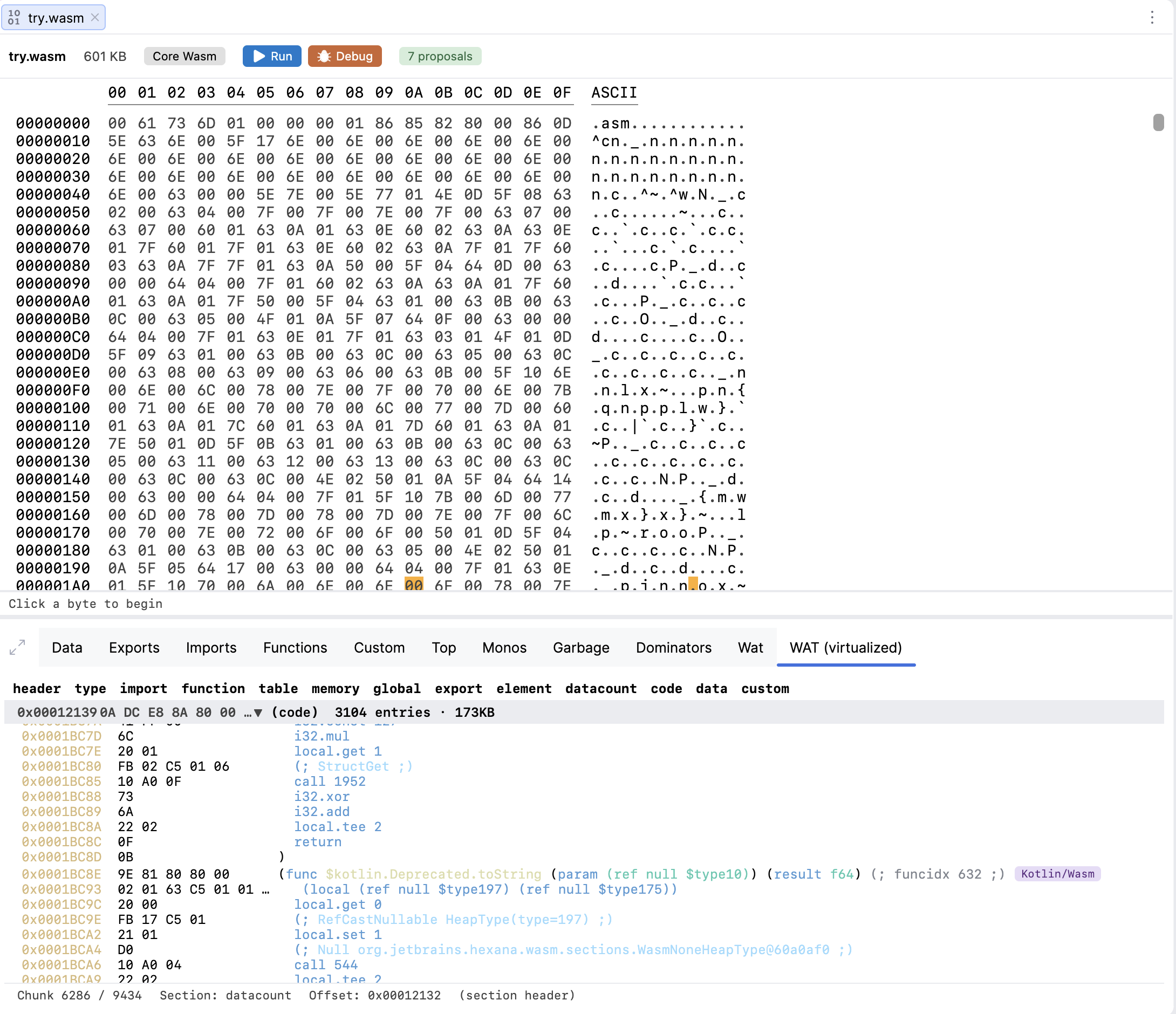
- Modules compiled by the Kotlin/Wasm backend are detected by their
kotlin.wasm.internal.*import fingerprint and tagged with a Kotlin/Wasm badge on the Functions tab and the virtualised WAT view. - Clicking a function's badge navigates to its Kotlin source declaration, resolved from the plain fully-qualified names the Kotlin/Wasm backend writes into the name section. Constructors, property accessors, and
$default/$lambdasynthetics are handled; overloads that share a name resolve to the method declaration. - Detection keys on the import field-name prefix rather than the host module, so it works across Kotlin versions (current
js_code, olderenv) and does not misfire on GraalVM Web Image or Emscripten, which also emit WasmGC.
Fixed
- The virtualised WAT view no longer throws
IllegalArgumentException: Key … was already used(and freezes) when scrolling or navigating a module whose name section repeats a function name. Kotlin/Wasm emits the same name (<init>, property accessors,$default, overloads) at many function indices, so this affected Kotlin/Wasm modules in particular. Per-function chunk identity now disambiguates the collisions; this also fixes navigation that could land on the wrong same-named function, and fold state that collapsed across same-named functions. Custom-section headers with duplicate names are disambiguated the same way.
0.11 — Node.js / browser runtimes and GraalVM Native Image
Released 2026-06-11.
Node.js and browser runtimes
WASM run/debug configurations can now target Node.js and the browser (Chrome) in addition to Wasmtime, WAMR, and GraalWasm.
- Run under Node.js or the browser — Hexana generates the host glue and launches the module.
- Debug is supported for both: the browser path drives Chrome through the Chrome DevTools Protocol; Node.js uses its built-in inspector. (DWARF-backed
lldbdebugging via Wasmtime and WAMR is unchanged.)
See run-and-debug.md for the full runtime matrix.
GraalVM Native Image detection
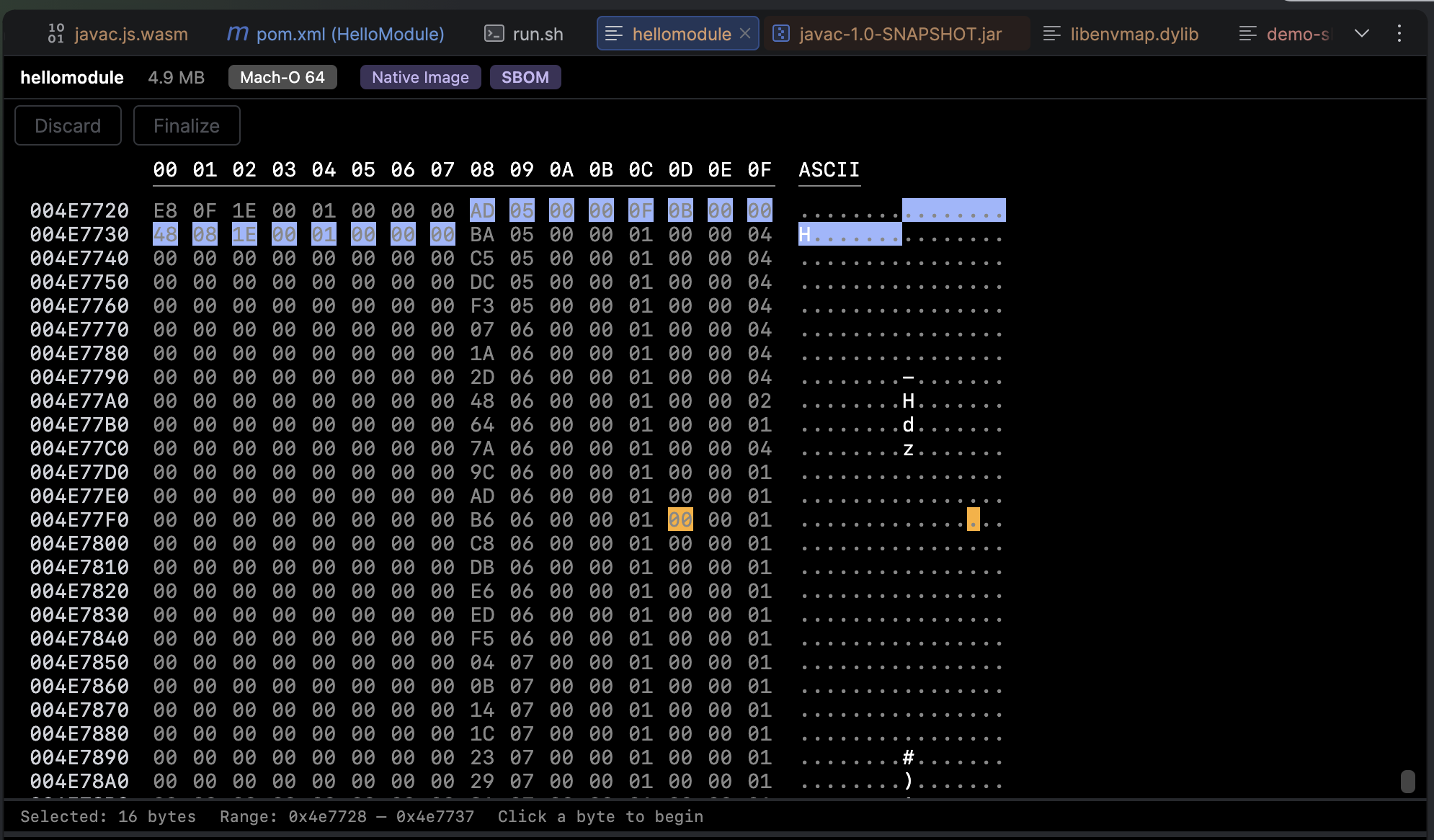
Executables and shared libraries produced by native-image (ELF, Mach-O, PE) are recognised by their SubstrateVM fingerprint — the com.oracle.svm.core.VM=GraalVM … identity string, .svm_* / __svm* sections, and the __svm_version_info marker — and tagged with a Native Image badge. The tooltip reports the GraalVM version, edition, and target platform. Because the identity string lives in read-only data, detection survives release stripping.
Embedded SBOM viewer
Native Image binaries built with --enable-sbom (default-on in Oracle GraalVM for JDK 25+) carry an embedded CycloneDX software bill of materials. Hexana adds an SBOM badge and a dedicated SBOM tab:
- A metadata header — subject, timestamp, generating tool.
- A searchable, sortable component table — type, group, name, version, licences, PURL.
- A View raw JSON action that shows the decompressed CycloneDX document.
SBOM vulnerability reachability
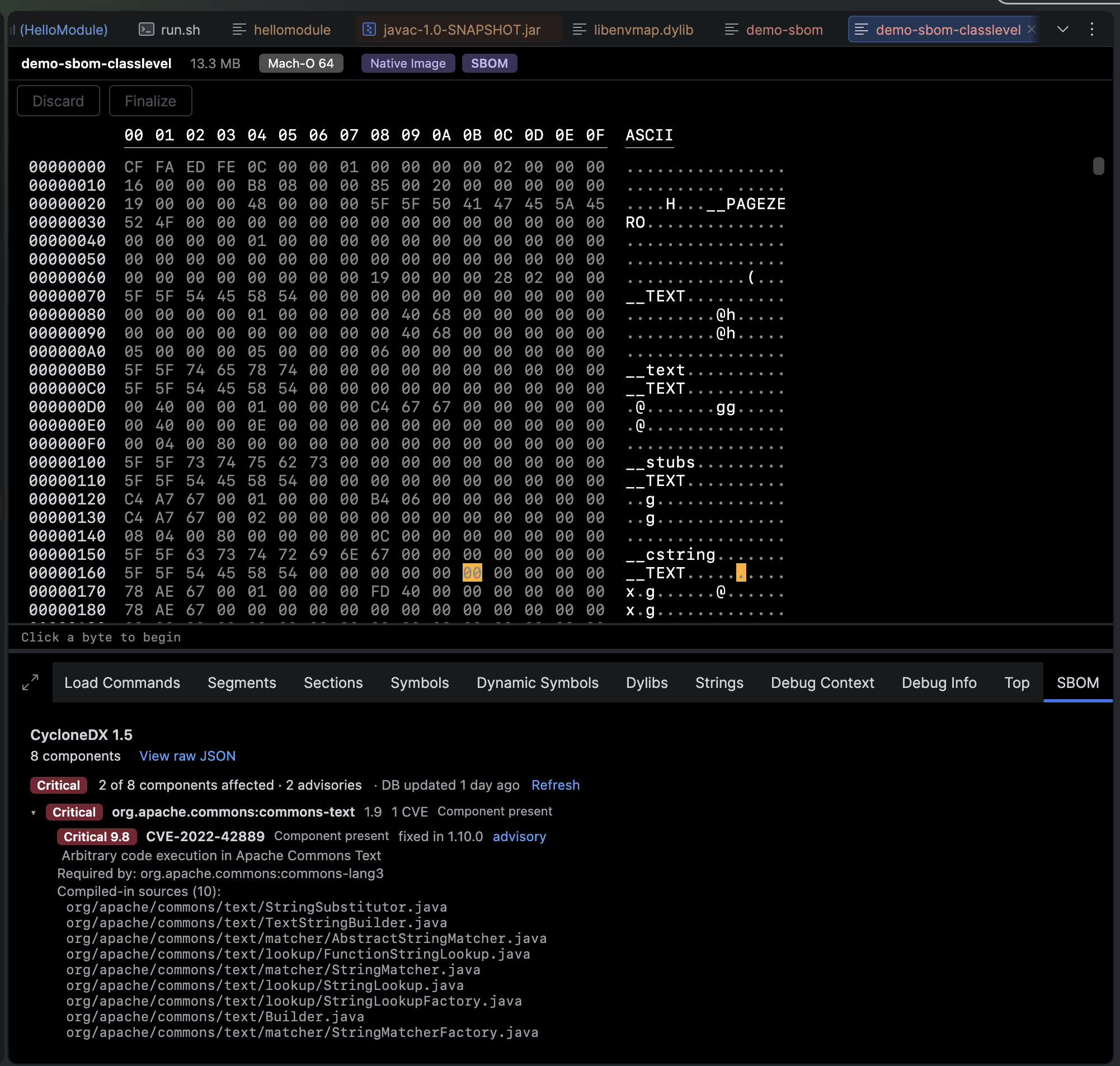
The SBOM tab can match its components against the OSV vulnerability database and overlay known CVEs with CVSS severity, the fixed version, and an advisory link.
- Because a component only appears in the SBOM if
native-imageretained it, every CVE shown is for code that actually survived dead-code elimination — not a vulnerability in a dependency the image dropped. - Binaries built with
--enable-sbom=class-levelembed a compiled-in class/method tree; for those, Hexana refines the verdict to "vulnerable class retained" vs "eliminated by DCE". - Matching is offline by default — the OSV database is downloaded once and the component list never leaves your machine. An opt-in toggle additionally queries
api.osv.devonline.
Both toggles live under Settings → Tools → Hexana and are off until enabled. See settings.md.
Changed
- WASM debugging on Windows — more reliable breakpoint handling. If breakpoints did not bind on Windows for you before, they should now.
Patch releases since 0.10
These patch releases shipped between 0.10 and 0.11:
- 0.10.3 (2026-06-10) — statistics-reporting fix.
- 0.10.2 (2026-06-03) — GraalVM Web Image
.wasmdetection with a Java badge that jumps to the originating Java bytecode; the.jitviewer split into Combined / Bytecode / Machine Code tabs with per-tab copy and Go-To-Offset; search compiled methods by inlined callee (in:<method>); an Instrument JMH forks option that attaches the JIT dump agent to each forked JMH JVM; foldable custom sections in the virtualised WAT view; and several large-binary responsiveness fixes (Top tab, WasmGC(rec …)type groups, WAT rebuild-on-recomposition). - 0.10.1 (2026-05-29) — list entries for plain ZIP files, a missing scrollbar on the archive entry list, and JIT-binary open fixes.
Upgrading
To 0.11.1 (from 0.11)
No breaking changes.
- Compare WASM With… and Kotlin/Wasm detection are automatic; they add an action and badges and never displace an existing editor. The module diff runs entirely on your machine — nothing is sent anywhere.
- The symbol-map sidecar for de-minified matching is opt-in: drop a
<file>.symbolsfile next to the.wasmonly if you have one.
To 0.11 (from 0.10)
No breaking changes.
- Existing run configurations continue to work. The new Node.js / browser runtimes are additional choices in the runtime picker.
- Native Image detection and the SBOM tab are automatic for matching binaries; they add tabs and badges and never displace an existing editor.
- SBOM vulnerability matching is off by default — no database is downloaded and nothing is sent anywhere until you enable it in Settings.
Known limitations in 0.11
- The SBOM features apply to GraalVM Native Image binaries only — a native binary without an embedded SBOM gets the disassembly view but no SBOM tab.
- The online OSV query sends the component coordinate list to
api.osv.dev; it is off unless you explicitly enable it (and requires the offline matcher to be on first). - Browser debugging targets Chrome (via the Chrome DevTools Protocol). Other browsers are not yet wired for debug.
- Carryover from 0.10: native-binary support is experimental; the Cranelift / Redline disassembler backend is experimental; Java integration covers Java sources only; quick-fixes are not yet wired on the WebAssembly Java or WIT inspections.
Earlier releases
- Hexana 0.10 release notes — 0.10 (2026-05-27), plus the 0.10.1–0.10.3 patch line summarised above.
- Hexana 0.9 release notes — 0.9 (2026-05-07), 0.9.1 (2026-05-20).